Headache diary: free printable template
A one-month diary on two pages, for A4 or US Letter paper. It records what a neurologist asks about: which days you had a headache, how bad it was, what you took and whether it worked.
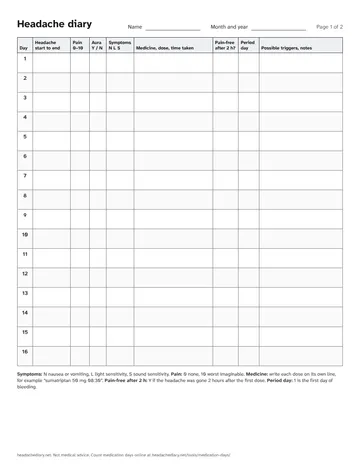
Two pages per month, 21 KB. Free, no sign-up. Print one copy for each month.
How to fill it in
Write one row per day. On days without a headache, leave the row empty unless you took medicine.
- Headache, start to end
- Clock times, for example 06:40–14:00. If it lasted more than a day, continue on the next row.
- Pain 0–10
- The worst pain of the day. 0 is no pain, 10 is the worst pain you can imagine.
- Aura
- Y if you had visual, sensory or speech symptoms before or during the headache, for example a zigzag line or flickering spot.
- Symptoms
- N for nausea or vomiting, L for sensitivity to light, S for sensitivity to sound.
- Medicine, dose, time taken
- Every acute medicine, one dose per line: name, dose and time. This column gives the medication-days count.
- Pain-free after 2 h
- Y if the headache was gone 2 hours after the first dose. Clinical trials of acute migraine medicine use the same measure.
- Period day
- 1 for the first day of bleeding, 2 for the second, and so on. Leave empty otherwise.
- Possible triggers, notes
- What happened in the 24 hours before: short sleep, a skipped meal, alcohol, travel, a change in weather.
How long to keep it
- At least 8 weeks before an appointment. NICE advises considering a headache diary for a minimum of 8 weeks. ICHD-3 notes that frequent headache generally requires a diary of at least one month to be characterised.
- Three months to see a pattern in medication days and in the MIDAS disability score, which also covers three months.
- At least three menstrual cycles if you suspect menstrual migraine, so the rule of attacks in two of three cycles can be checked. NICE diagnoses menstrual-related migraine from a diary over at least two cycles; ICHD-3 asks for three cycles in research. More on menstrual migraine.
What a month of entries shows
Fill in the month summary on page 2. Three numbers matter most:
- Days with headache. ICHD-3 defines chronic migraine as headache on 15 or more days a month for more than three months, with features of migraine on at least 8 of those days a month.
- Days with acute medicine, by type. 10 or more days a month with triptans, or 15 or more with simple painkillers, for more than three months, together with headache on 15 or more days a month, meets the medication-overuse criteria. Check your count.
- Days of work or school missed. Over three months, this feeds the MIDAS score.
Sources
- ICHD-3, 1.3 Chronic migraine. Frequent headache “generally requires a headache diary” kept for at least one month
- ICHD-3, A1.1 Menstrual migraine (appendix)
- NICE CG150. Headaches in over 12s: diagnosis and management. Recommendations. Consider a diary for a minimum of 8 weeks; at least two cycles for menstrual-related migraine
- ICHD-3, 8.2 Medication-overuse headache
- American Migraine Foundation: Headache journals
- The Migraine Trust: Headache diary
- Diener et al. Guidelines of the International Headache Society for controlled trials of acute treatment of migraine attacks in adults, 4th edition. Cephalalgia 2019;39(6):687–710. Pain freedom at 2 hours as the primary efficacy measure
Checked against these sources on 28 October 2026. How this page is written and checked